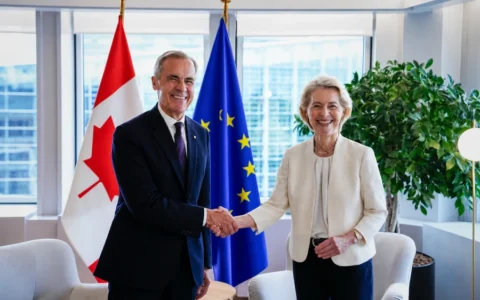

Canada could become the European Union’s first-ever “associate member” under a proposal that could reshape the country’s economic and strategic relationship with Europe.
European Commission President Ursula von der Leyen raised the prospect during her State of the Union address in Strasbourg on September 16, with Canadian Prime Minister Mark Carney in attendance.
“I would like to work with you on opening the door for Canada to be the first associate member of the EU,” von der Leyen said, adding that she wanted to take the Canada-EU relationship to “the highest level possible.”
The proposal does not mean Canada is joining the European Union. In fact, there is currently no formal “associate member” status under EU treaties.
Instead, the idea could go significantly beyond the existing Canada-EU partnership without amounting to full EU membership. Exactly what rights, market access and obligations such a relationship would involve has yet to be decided.
Canada has responded positively to the broader proposal. Following talks in Strasbourg, Carney’s office said he welcomed plans to move beyond the existing Canada-EU trade relationship toward a “far stronger, more ambitious alliance” that the two sides would define together.
What Would EU Associate Membership Actually Mean?
For now, “associate membership” is a political concept rather than an established legal category.
Canada cannot become a conventional EU member under the current framework, as full EU membership is open to European states. Full membership also comes with representation in EU institutions, voting rights, access to EU funding and participation in the bloc’s Single Market.
Carney has made clear that Canada is not seeking full membership. Instead, he has spoken about establishing a “unique alliance” with Europe that would deepen cooperation without Canada formally joining the bloc.
Von der Leyen’s proposal appears to provide a possible framework for that deeper relationship.
The challenge is that there is no existing template.
If the concept moves forward, Canada and the EU would need to negotiate what associate membership actually provides and what Canada would be required to accept in return.
From CETA to a Much Deeper Economic Relationship
Canada and the EU are already closely connected through the Comprehensive Economic and Trade Agreement, or CETA.
According to von der Leyen, trade in goods between the two sides has grown by 75% in less than a decade under CETA. But the relationship being discussed now could go significantly further than a conventional free-trade agreement.
Von der Leyen said Canada and Europe would move from CETA toward an “Alliance for the Future” and create what she described as a common prosperity and economic security space.
The areas identified for deeper cooperation include advanced manufacturing, technology, defense, energy, critical minerals, batteries, artificial intelligence, quantum technology, cybersecurity and the Arctic.
For Canada, deeper integration could potentially provide greater access to the EU’s €18 trillion Single Market.
But greater access would not necessarily come without conditions.
Countries such as Norway, Iceland and Liechtenstein participate in the Single Market through the European Economic Area. In return, they implement substantial parts of EU law despite not having the same decision-making rights as EU member states.
There is no indication yet that Canada would follow the same model, but the comparison illustrates the types of trade-offs that can come with deeper integration into the European market.
Could the Deal Include Greater Worker Mobility?
Another potentially significant part of the discussions is worker mobility.
According to The Wall Street Journal, Canada and the EU have been exploring greater worker mobility as part of a broader effort to deepen economic integration, particularly in strategically important sectors.
The Canadian government has also said discussions with European leaders have focused on giving citizens “more choice on where they travel, where they study, and where they trade and work.”
For now, however, no new mobility arrangement has been agreed.
Canadian citizens do not currently have a general EU-wide right to move to any member state and work there without meeting the immigration and employment requirements of that country.
The discussions should therefore not be interpreted as an offer of EU-style freedom of movement. Rather, expanded worker mobility is one of the ideas being explored as Canada and the EU consider how much further their economic and strategic relationship could go.
Why Is Canada Looking Toward Europe Now?
The push comes as Canada seeks to diversify its international economic relationships and reduce its heavy dependence on the United States.
Carney’s government has set a goal of significantly increasing Canada’s trade outside the U.S., while simultaneously deepening cooperation with European partners in areas including defense, technology, critical minerals and energy security.
Europe has its own reasons for pursuing closer ties.
Von der Leyen has argued for stronger partnerships with countries that share the EU’s interests in economic security, defense, technology and critical supply chains.
For both sides, the proposed relationship is therefore much broader than trade alone.
The Canadian government has said discussions with the EU cover areas including critical minerals, defense, artificial intelligence, energy security, space, financial services and payments.
What Happens Next?
Despite the scale of the announcement, Canada is not about to become an EU associate member overnight.
There is currently no indication that Brussels intends to create “associate membership” by amending the EU treaties. If treaty changes were ultimately required, they would need unanimous agreement among the 27 member states and domestic ratification.
Before reaching that point, Canada and the EU would first need to define what the proposed relationship actually involves.
Negotiators would have to address questions around market access, regulatory alignment, investment, worker mobility and the balance between deeper integration and Canadian sovereignty.
For now, major details remain unresolved, including how much additional Single Market access Canada could receive, what regulatory commitments might be required and whether any future arrangement would include expanded mobility rights.
What is clear is the direction of travel.
Canada and the EU are no longer discussing only another trade agreement or another area of bilateral cooperation. They are exploring whether to build an entirely new type of relationship.
If that effort succeeds, Canada could become the first country to test what being an “associate member” of the European Union actually means.